How to Manage Credit Debt: The 2026 Reference for Fiscal Autonomy
The institutionalization of consumer credit has created a landscape where debt is no longer an anomaly but a structural component of the modern financial lifecycle. In 2026, the complexity of revolving credit instruments, combined with fluctuating interest rate environments, requires a shift from reactive “bill-paying” toward a rigorous, treasury-style management of household liabilities. To engage with credit today is to participate in a sophisticated game of interest rate arbitrage and liquidity management, where the cost of a single miscalculation can compound over decades.
The challenge in modern debt management lies in the “Invisibility of Compounding.” Unlike a mortgage or an auto loan, which follow a predictable amortization schedule, credit card debt is a dynamic, open-ended liability. Its growth is non-linear, often decoupled from the initial purchase, and driven by the mathematics of daily periodic rates. Consequently, a definitive reference on this subject must move past the elementary “spend less” platitudes and interrogate the structural mechanics that allow debt to become a self-perpetuating system.
Successfully navigating a high-debt scenario demands an analytical detachment from the psychological weight of the balance. It requires the borrower to view their debt as a “short position” on their future income, a liability that must be closed out with the same precision a fund manager uses to exit a failing trade. This editorial pillar provides the conceptual scaffolding and technical protocols necessary to deconstruct complex debt profiles and restore long-term fiscal autonomy.
Understanding “how to manage credit debt.”
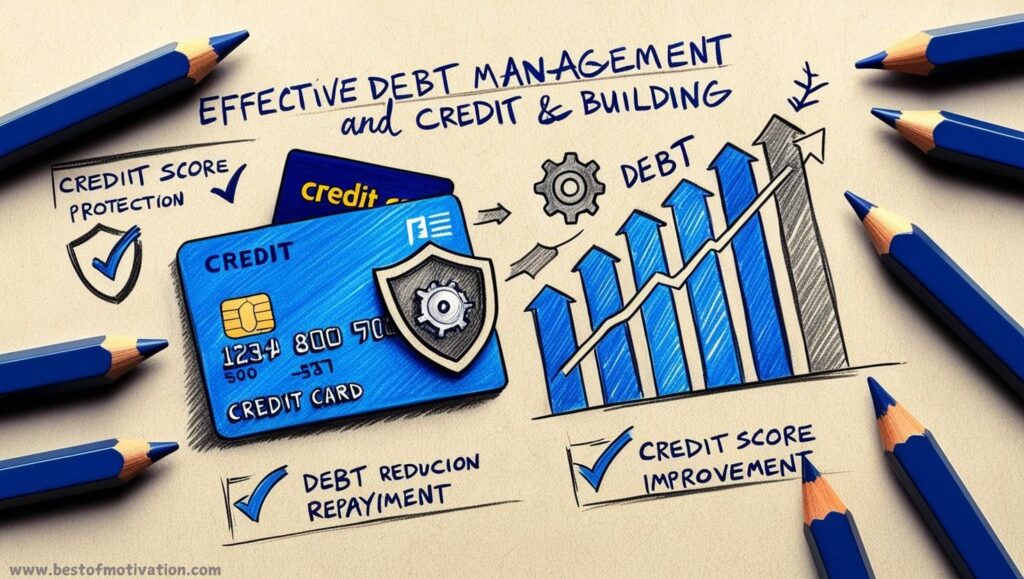
To fundamentally grasp how to manage credit debt, one must apply a “Weighted Cost” filter to every dollar of household cash flow. This is not merely an exercise in budgeting; it is a tactical intervention in a high-interest environment. The goal is to maximize “Principal Velocity,y”, the speed at which the original borrowed amount is reduced, ed while minimizing the “Interest Leakage” that fuels the issuer’s profitability.
Multi-Perspective Explanation
From a Mathematical Perspective, credit debt is a high-cost capital obstacle. If a borrower has an emergency fund earning 4% in a high-yield savings account while carrying a credit card balance at 24%, they are effectively losing 20% on every dollar kept in “savings.” Management, in this view, is the process of neutralizing this spread through aggressive balance liquidation or rate compression.
From a Behavioral Perspective, management is about “Constraint Engineering.” It involves identifying the specific metabolic triggers, ers whether they are “Lifestyle Creep,” “Income Volatility,” or “Emergency Fragility” that led to the initial reliance on revolving credit. Without addressing the underlying causality, any technical repayment strategy will act only as a reprieve rather than a permanent solution.
From an Administrative Perspective, excellence is found in “Inventory Clarity.” Most borrowers do not have a unified view of their debt; they have fragmented accounts with varying APRs, statement dates, and penalty triggers. Management requires a centralized “Debt Ledger” that tracks the total cost of carry across the entire household ecosystem.
Oversimplification Risks
A pervasive risk is the “Minimum Payment Trap,” where the borrower believes they are “managing” the debt simply by staying current. In reality, a minimum payment is designed by the issuer to maximize the interest-bearing life of the loan. Another risk is the “Consolidation Fallacy”—believing that moving debt to a lower-interest personal loan “solves” the problem. Without a corresponding reduction in spending velocity, consolidation often leads to “Double-Dipping,” where the borrower clears the cards only to run them up again while still owing the consolidation loan.
Contextual Background: The Financialization of Consumption
The evolution of credit has moved from “Relational Lending” to “Algorithmic Underwriting.” In the Pre-Digital Era, credit was a tool for specific, high-ticket purchases. It was gated by human loan officers and had a clear beginning and end.
The Expansion Era (1990–2015) introduced the “Always-On” credit line. Revolving credit became the primary payment rail, and rewards programs were used to incentivize high-velocity spending. This period saw the “Normalization of Carry,” where carrying a monthly balance became a standard middle-class experience.
By 2026will, we have entered the Era of Predictive Debt. Issuers now use machine learning to identify which borrowers are likely to carry a balance without defaulting, leaving the “revolvers” who are most profitable to the bank. The infrastructure of modern commerce is now built to facilitate “frictionless” debt, from “Buy Now, Pay Later” (BNPL) integrations to automated credit limit increases. In this context, managing debt is an act of rebellion against a system designed to keep capital in a state of permanent motion.
Conceptual Frameworks and Mental Models
1. The “Snowball vs. Avalanche” Efficiency Frontier
This framework compares the psychological yield of the “Snowball” method (paying the smallest balances first for a “win”) against the mathematical yield of the “Avalanche” method (paying the highest interest rates first). While the Avalanche is logically superior, the Snowball is often behaviorally resilient. The “Management” choice depends on the borrower’s history of adherence to long-term plans.
2. The “Interest-to-Income” (ITI) Ratio
A mental model for measuring “Debt Gravity.” If more than 10% of a household’s net income is diverted to interest payments, the debt has reached a “Critical Mass” where it begins to outpace the household’s ability to save for the future.
3. The “Opportunity Cost of Liquidity.”
This model treats debt repayment as a “Guaranteed Return.” Paying off a 20% APR credit card is functionally identical to finding an investment that pays a guaranteed 20% return. In a market where 7–10% is the norm, debt repayment is the most efficient use of capital available to the average person.
Key Categories of Debt Resolution Architectures
| Category | Primary Strategic Focus | Key Trade-off | Ideal Use Case |
| Organic Aggressive Paydown | Maximizing principal velocity from cash flow. | High temporary lifestyle sacrifice. | High-income households with high debt. |
| Balance Transfer Hubs | 0% APR “Breathing Room” for 12–21 months. | Upfront 3–5% transfer fees. | Borrowers with high credit scores. |
| Consolidation Loans | Converting revolving debt to a fixed-term. | Risks of “double-dipping” on cards. | Simplifying multiple payment dates. |
| Hardship Programs | Negotiating lower rates with the issuer. | Closes the account permanently. | Significant income loss or medical crisis. |
| Debt Management Plans (DMP) | Third-party structured repayment. | Significant initial credit score impact. | Borrowers who cannot manage the admin. |
Detailed Real-World Scenarios and Decision Logic
The “Variable Income” Freelancer
A creative professional has $12,000 in debt across three cards, with monthly income fluctuating by 40%.
-
The Logic: They cannot commit to a high “Fixed” monthly payment.
-
The Decision: Establishing a “Baseline Minimum” and using “Windfall Accounting”—directing 80% of any “above-average” month’s income specifically to the highest-interest card.
-
Failure Mode: Treating a high-income month as “bonus” money while only paying minimums during low-income months.
The “Dual-Career” Trap
A couple has $40,000 in debt but maintains a high savings rate.
-
The Logic: Their “Cash-on-Hand” is being eroded by the interest spread.
-
The Action: A “Liquidity Sweep”—using 75% of non-emergency savings to instantly kill the highest interest debt.
-
Second-Order Effect: They lose the “Security Blanket” of cash but gain $800/month in freed-up cash flow that was previously going to interest.
Planning, Cost, and Resource Dynamics

The “Cost of Carrying” debt includes both the explicit interest and the implicit loss of future growth.
2026 Debt Carry Cost Mapping (Sample $10,000 Balance)
| APR Level | Monthly Interest Cost | 12-Month “Leakage” | Opportunity Cost (7% Invested) |
| 12% (Credit Union) | $100 | $1,200 | $700 |
| 18% (Standard) | $150 | $1,800 | $700 |
| 24% (Premium/Store) | $200 | $2,400 | $700 |
| 29% (Penalty) | $241 | $2,892 | $700 |
Tools, Strategies, and Support Systems
-
Amortization Simulators: Using “What-If” calculators to see how an extra $100/month shortens the debt life from 15 years to 3 years.
-
“Statement Cycle” Alignment: Moving all credit card due dates to the same day (e.g., the 5th of the month) to simplify treasury management.
-
Automatic “Excess-Cash” Sweeps: Setting a bank rule that anything over $1,000 in a checking account at the end of the month is sent to the debt.
-
Credit Score “Guardians”: Monitoring utilization ratios to ensure that as debt is paid down, the score rises, unlocking better consolidation rates.
-
0% APR Calendar Tracking: Rigidly marking the expiration date of teaser rates to avoid the 29% “Reversionary Jump.”
-
“Cash-Only” Transitional Period: Freezing all credit card use for 90 days to reset the metabolic relationship with spending.
Risk Landscape and Taxonomy of Failure Modes
-
“The Consolidation Trap”: Getting a low-interest loan to pay off cards, but not closing the cards, leading to a doubled debt load within 18 months.
-
“The Emergency Paradox”: Paying off all debt but having $0 in cash, forcing the borrower to use the credit card for a car repair, thus restarting the cycle.
-
“The Balance Transfer Carousel”: Constantly moving debt from one 0% card to another, paying 3% fees each time, which effectively acts as a 3% annual interest rate while masking the lack of principal reduction.
-
“The Settlement Scam”: Paying “Debt Settlement” companies that advise the borrower to stop paying their bills, resulting in lawsuits and destroyed credit.
Governance, Maintenance, and Long-Term Adaptation
Effective management requires a “Quarterly Debt Audit.”
-
Adjustment Triggers:
-
A Federal Reserve rate hike (Time to look for a fixed-rate consolidation loan).
-
A 20-point increase in credit score (Time to negotiate lower APRs with existing issuers).
-
A “Zero Balance” achievement (Time to automate a transfer of that former “payment” into a brokerage account).
-
-
Maintenance Checklist:
-
Verify the “Actual APR” on all accounts (Issuers often change these with notice).
-
Confirm no “Penalty APRs” have been triggered by accidental late payments.
-
Audit “Ghost Subscriptions” on cards that are supposedly “off-limits.”
-
Measurement, Tracking, and Evaluation
-
Leading Indicators: “Principal-to-Interest Ratio” (What % of your payment actually lowers the balance?); “Utilization per Line.”
-
Lagging Indicators: “Net Worth Delta” (The monthly increase in net worth as liabilities shrink); “Total Monthly Interest Expense.”
-
Documentation Examples:
-
The “Burn-Down Chart”: A visual graph showing the debt balance trending toward zero over time.
-
The “Interest Ledger”: A cumulative tally of all interest paid to date, used as a “Negative Incentive” to stay focused.
-
Common Misconceptions and Oversimplifications
-
“I should keep a balance to help my credit score”: Factually false. Paying in full is always better for the score and the wallet.
-
“Closing a card always hurts my score.: It may temporarily, but the “Behavioral Safety” of removing a temptation often outweighs a 10-point score dip.
-
“Zero-percent offers are ‘free’ money”: Only if you pay them off. If you miss a payment, many of these cards retroactively apply interest from the start.
-
“I need to pay off the highest balance first”: Only if it also has the highest interest rate. Mathematically, balance size is irrelevant; interest rate is the “velocity” of the debt.
-
“Bankruptcy is the end of my life”: For extreme, unmanageable debt, it is a legal tool for a fresh start. It is a “Financial Reboot,” not a moral failure.
-
“I can’t negotiate with a big bank”: You often can, especially if you have been a long-term customer or can prove temporary hardship.
Ethical and Practical Considerations
In a society that treats debt as the “fuel” for economic growth, deciding to become debt-free is an act of strategic withdrawal. Practically, this requires a “Counter-Cultural” mindset—valuing “Ownership” over “Access.” Ethically, one must recognize that credit issuers are profit-maximizing entities; their interests are fundamentally opposed to yours. Managing debt is not just about money; it is about reclaiming the “Time” you would otherwise have to work to pay for the “Interest” on your past.
Conclusion
To master how to manage credit debt is to transition from a “Subject” of the credit system to its “Operator.” There is no alchemy in debt reduction; there is only the clinical application of cash flow against the highest-velocity liabilities. By deconstructing the mathematical traps of the credit industry, utilizing the “Avalanche” of principal reduction, and maintaining a rigorous governance structure, a household can transform a cycle of permanent interest into a foundation of permanent wealth.